

YUVEZZI Efficacy:

Near vision significantly improved with one drop, once a day1

Actor portrayal of woman applying YUVEZZI eye drops for presbyopia

Primary endpoint: Significantly more patients achieved ≥3-line gain BUCNVA without ≥1-line loss in BUCDVA with YUVEZZI than with vehicle or monotherapies1

BUCNVA = binocular uncorrected near visual acuity; BUCDVA = binocular uncorrected distance visual acuity.

The efficacy of YUVEZZI was rigorously evaluated

YUVEZZI was studied in over 600 presbyopia patients (healthy males and females aged 45 to 80) across two Phase 3 randomized, double-masked, controlled studies, BRIO I and BRIO II.1

BRIO I and BRIO II Study Designs

YUVEZZI demonstrated near-vision improvement, with rapid onset at 30 minutes through 8 hours1

Proportion of participants from BRIO I and BRIO II studies achieving a gain from baseline of 3 lines (15 letters) or more in BUCNVA without a loss of 1 line (5 letters) or more in BUCDVA

Significantly more patients achieved ≥3-line gain BUCNVA without ≥1-line loss in BUCDVA with YUVEZZI than with vehicle or monotherapies.1

  • P values are for comparisons to YUVEZZI.
  • N is the number of participants in the study arm.
  • BUCDVA, binocular uncorrected distance visual acuity, BUCNVA, binocular uncorrected near visual acuity.

YUVEZZI was studied in over 600 presbyopia patients (healthy males and females aged 45 to 80) across two Phase 3 randomized, double-masked, controlled studies, BRIO I and BRIO II1

BRIO I
BRIO II

BRIO I

Superiority vs a cholinergic alone1,2

YUVEZZI was significantly superior to carbachol across multiple timepoints1,2*

  • Designed to evaluate the superiority of YUVEZZI over either active monotherapy1
  • Crossover study in which 182 subjects received a single administration of 1 drop of YUVEZZI, cholinergic, and brimonidine in each eye, with at least 3 days between treatments1

Primary endpoint:

Gain from baseline of ≥3 lines (15 letters) in binocular uncorrected near visual acuity (BUCNVA) without a loss of ≥1 line (5 letters) in binocular uncorrected distance visual acuity (BUCDVA).1

Treatment visits:

  • 4 total in-clinic visits, including screening, randomization, and treatment with investigational products2

Visual inclusion criteria:

  • Pupil size ≥4.25 mm in both eyes and difference in pupil size between eyes of <1 mm under mesopic conditions2
  • Monocular uncorrected near visual acuity (MUCNVA) of ≤65 ETDRS letters (Snellen equivalent of 20/50 or worse) in each eye under mesopic conditions2
  • BUCNVA of ≤65 ETDRS letters (Snellen equivalent of 20/50 or worse) under mesopic conditions2
  • Binocular near visual acuity improvement of ≥18 letters at 40 cm with pinhole occlusion compared with BUCNVA under mesopic conditions2

97.8% of study participants were phakic and 2.2% were pseudophakic2

*In BRIO I, YUVEZZI was also superior to brimonidine tartrate across multiple timepoints.2 

BRIO II

Sustained functional near vision1

YUVEZZI demonstrated significantly greater efficacy compared to vehicle though Hour 81

  • Subjects were administered 1 drop of YUVEZZI or vehicle once daily for up to 360 days1
  • 436 subjects were randomized for a single administration of 1 drop of YUVEZZI or vehicle (218 to each group) in each eye1

Primary endpoint:

Gain from baseline of ≥3 lines (15 letters) in binocular uncorrected near visual acuity (BUCNVA) without a loss of ≥1 line (5 letters) in binocular uncorrected distance visual acuity (BUCDVA).1

Secondary endpoints:

Proportion of subjects with a Snellen equivalent of 20/40 vision or better (≥68 letters) in mesopic BUCNVA at 40 cm using both eyes at each timepoint.3

Mean change from pre-dose baseline in binocular uncorrected high-contrast reading speed (BUHCRS) using the MNRead chart at pre-dose and 1 hour post-dose using both eyes under mesopic conditions at Days 90 and 180.3

Treatment visits:

  • In-clinic dosing visits (6): Days 1, 7, 90, 180, 270, and 3603
  • At-home treatment: Participants completed an electronic 7-day diary 5 times, starting on Days 15, 81, 171, 261, and 3513
  • 6-month open-label extension: Featured 3 in-clinic dosing visits and at-home treatment (Days 181 to 360)3

Visual inclusion criteria:

  • Pupil size ≥4.25 mm in both eyes and difference in pupil size between eyes of <1 mm under mesopic conditions3
  • Monocular uncorrected near visual acuity (MUCNVA) of ≤65 Early Treatment Diabetic Retinopathy Study (ETDRS) letters (Snellen equivalent of 20/50 or worse) in each eye under mesopic conditions (≤70 ETDRS letters or 20/40 or worse for safety-only cohort)3
  • BUCNVA of ≤65 ETDRS letters (Snellen equivalent of 20/50 or worse) under mesopic conditions (≤70 ETDRS letters or 20/40 or worse for safety-only cohort)3
  • Binocular near visual acuity improvement of ≥18 letters at 40 cm with pinhole occlusion compared with BUCNVA under mesopic conditions (not applicable for safety-only cohort)3

95.5% of study participants were phakic and 4.5% were pseudophakic3

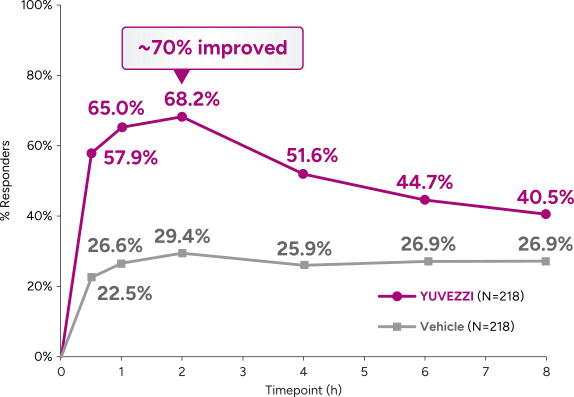
Significant and sustained functional near vision improvement

Functional Near Vision

~70%

Nearly 70% of patients achieved 20/40 or better near visual acuity at Hour 2 with YUVEZZI3*
Reading Speed

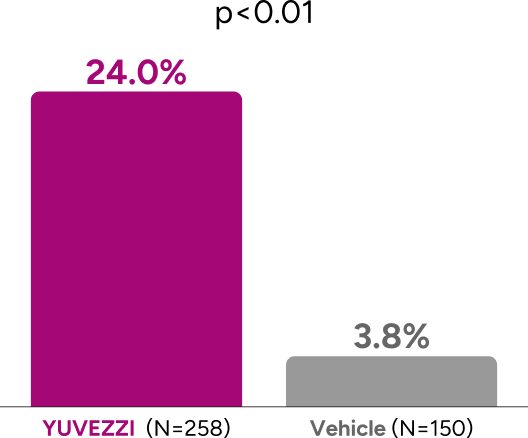
6

+

6x greater improvement in reading speed at 3 months with YUVEZZI compared to vehicle3
No evidence of tachyphylaxis with YUVEZZI  from the first administration to 12 months3

Tachyphylaxis is a diminished response to successive doses of a drug, rendering it less effective over time.5

*

Proportion of subjects with a Snellen equivalent of 20/40 vision or better (≥68 letters) in mesopic BUCNVA at 40 cm using both eyes at each timepoint (including Hour 0) for YUVEZZI vs vehicle (Days 7, 270, and 360).3